Research
Members of Isentropic Robotics write up their work on competitive robotics as papers. Each entry below gives the abstract, and opens to a plain-language summary, the methods and results, and the reference list. Where the full manuscript can be shared, a request form follows the entry.
Research entries
Reliability-Oriented Evaluation of State Estimation for VEX Robotic Systems: A Sensor Fusion Approach
October 2, 2026Reliable motion state estimation in autonomous robots is challenged by sensor noise, outlier measurements, and accumulated drift, particularly in dynamic competition environments. This paper presents a reliability-oriented framework for evaluating three estimators on the resource-constrained VEX V5 robotic system: Exponentially Weighted Moving Average (EWMA), Information Filter (IF), and Invariant Extended Kalman Filter (IEKF) on SE(2). These methods are evaluated through repeated physical experiments and calibrated simulations for accuracy, robustness, and computational cost. Across ten four-lap trials, mean final position error decreased from 22.17 cm for unfiltered dead reckoning to 4.81 cm for the IF and 4.32 cm for the IEKF. In the calibrated slalom simulation, the IEKF achieved slightly lower position absolute trajectory error (ATE) and heading root mean square error (RMSE) than the IF. Robustness tests further showed that neither Kalman-family estimator inherently rejected large GPS outliers, whereas GPS dropout was comparatively well tolerated. Analytical operation counts indicated that the IEKF required approximately 8.8 times as many arithmetic operations per update as the IF. Overall, the results highlight the trade-offs among estimation accuracy, measurement robustness, and computational cost, while the proposed framework provides a systematic basis for evaluating state estimators on low-cost, resource-constrained robotic platforms.
Synopsis, methods, and results
A VEX V5 robot that relies on wheel encoders and an inertial sensor alone drifts further from its true position with every lap. This paper tests three ways of filtering those measurements, from a simple moving average to a Kalman-family filter that uses the field GPS to correct itself. The two GPS-corrected filters cut the final position error of a 16 m course from about 22 cm to under 5 cm; the more sophisticated of the two is slightly more accurate but costs almost nine times as many arithmetic operations, and its heading estimate is more sensitive to bad GPS readings.
Prepared for the 2027 Annual Reliability and Maintainability Symposium (RAMS). Keywords: autonomous systems, motion state estimation, reliability evaluation, sensor fusion.
Motivation
Autonomous performance in VEX Robotics depends on onboard inertial, rotation, encoder, and positioning measurements for odometry, navigation, and interaction with field elements. Those measurements carry noise, occasional outliers, and errors that accumulate: a short-term disturbance can misalign the robot with a field element, and repeated integration of small errors produces long-term drift that degrades autonomous performance over the course of a match.
Filtering reduces the influence of measurement noise on program-critical state estimates, but choosing an estimator for the V5 platform means balancing drift suppression, outlier robustness, and computational cost. Existing studies of filtering for differential-drive robots concentrate on general mobile platforms or idealized simulations, and give little attention to the specific sensing, computational, and operational constraints of V5. Outlier robustness matters in particular: the VEX Push Back field offers opportunities to correct the robot’s pose physically against field structures, and while small localization errors may be mechanically tolerated during those interactions, a large estimation outlier can prevent the alignment and eliminate the intended reset.
Estimators considered
Candidate filters were screened on computational cost, outlier handling, and drift handling.
Table 1. Comparison of candidate filters for VEX V5. Filter Computational cost Outlier handling Drift handling EWMA Very low; simple recursive update Poor to moderate; sensitive to large spikes Poor; does not correct long-term drift Kalman Filter (standard form; not implemented) Low to moderate; efficient for simple models Moderate; sensitive to large outliers Good; reduces accumulated drift with measurement updates Information Filter Moderate; comparable to Kalman filtering Moderate; sensitive to large outliers Good; reduces drift with reliable updates SE(2) IEKF Moderate; nonlinear propagation and small matrix operations Moderate; no inherent outlier rejection Good; combines motion propagation with absolute corrections in a coupled pose model Particle Filter High; cost increases with particle count Potentially robust; accommodates non-Gaussian noise and outliers Good; can correct accumulated drift when informative measurements are available Three estimators were implemented and evaluated. The Exponentially Weighted Moving Average (EWMA) provides simple recursive smoothing with constant memory and a single smoothing parameter, but it is not model-based, receives no absolute correction, and can introduce response lag during rapidly changing motion. The Information Filter (IF) is a conventional Kalman-family estimator in information form, with one scalar filter per pose component (x, y, heading); its prediction step is driven by encoder and inertial increments and its update step by periodic V5 GPS measurements. The Invariant Extended Kalman Filter (IEKF) on SE(2) represents the planar pose on the Lie group of rigid-body motion and propagates a full 3 by 3 covariance, so it can capture the coupling between heading error and position error during turns that the per-channel IF cannot. The standard Kalman Filter was not implemented separately because the IF is an equivalent formulation under the linear-Gaussian assumptions of the study, and particle filtering was excluded because its per-update cost scales with the particle count.
Platform constraints
The V5 Brain provides a Cortex-A9 user processor, 128 MB of RAM, and 32 MB of flash for user programs, which motivates fixed-size state representations and bounded update cost. Rotation-sensor values are copied into a shared buffer every 10 ms, so polling faster yields no newer measurement; a discrete time step of 0.01 s was adopted for every estimator. The V5 inertial sensor supplies heading and angular rate, rotation sensors and motor encoders supply incremental motion, and the field-based V5 GPS supplies periodic absolute position and heading used only as a correction input to the IF and IEKF.
Physical experiments
A VEX V5 robot drove four consecutive laps around a 1 m by 1 m square on a representative Push Back field layout, roughly 16 m in total, with four straight segments and four 90 degree turns per lap. Ten runs were recorded, and all four configurations (unfiltered dead reckoning, EWMA, IF, and IEKF) were evaluated on the same sensor measurements from each run. Ground truth came from an external camera tracking an AprilTag on the robot, independent of the GPS measurements used for correction; endpoint error was also measured against a marked field location at the end of each lap.
Table 2. Four-lap physical experiment results, ten runs. Position error in cm, mean ± standard deviation; lap-end rows are the mean endpoint error. Metric No filter EWMA IF IEKF Final error 22.17 ± 1.11 18.78 ± 0.91 4.81 ± 0.24 4.32 ± 0.20 Mean ATE 13.62 ± 0.65 18.16 ± 0.89 3.17 ± 0.13 2.87 ± 0.09 Peak error 30.33 ± 1.49 26.11 ± 1.20 8.78 ± 0.40 7.10 ± 0.30 End of lap 1 7.9 6.8 1.2 0.9 End of lap 2 11.4 10.1 2.2 1.7 End of lap 3 17.2 13.9 2.9 3.1 End of lap 4 22.2 18.8 4.8 4.3 Unfiltered dead reckoning drifted steadily, with lap-end errors of 7.9, 11.4, 17.2, and 22.2 cm. The GPS-corrected IEKF and IF achieved mean absolute trajectory errors of 2.87 cm and 3.17 cm, reductions of approximately 79 percent and 77 percent relative to the unfiltered configuration. EWMA reduced the final and peak errors but its mean ATE (18.16 cm) exceeded the unfiltered value (13.62 cm): smoothing alone did not prevent accumulated error.
Simulation stress test
Because the physical trials evaluate position only, a calibrated discrete-time simulation was used to examine heading performance under sustained rotation. The simulation uses a 10 ms update period, encoder quantization, inertial heading noise and bias, and 200 ms GPS updates, with noise parameters estimated from the physical robot: gyro rate noise and bias from ten repeated 1 m straight-line drives, encoder noise by regression over straight-line drives of several distances, and GPS position and heading noise from a stationary robot at a known field location. The configured values were a 0.30 m track width, a 34.9 mm wheel radius, encoder noise of 0.20 mm per step, gyro rate noise of 0.015 degrees per step, a per-run gyro bias with standard deviation 0.0006 degrees per step, GPS position noise of 1.5 cm, GPS heading noise of 1.00 degrees, and an EWMA time constant of 40 ms (smoothing parameter 0.22).
A slalom trajectory with repeated alternating turns served as the heading-dynamics stress test. Twenty random seeds were evaluated per estimator.
Table 3. Slalom simulation results, 20 seeds, mean ± standard deviation. Metric No filter EWMA IF IEKF Heading RMSE (°) 0.60 ± 0.02 3.15 ± 0.09 0.49 ± 0.02 0.46 ± 0.02 ATE (cm) 1.77 ± 0.05 3.04 ± 0.09 0.92 ± 0.05 0.85 ± 0.03 Final error (cm) 2.34 ± 0.07 1.14 ± 0.03 0.64 ± 0.04 0.64 ± 0.03 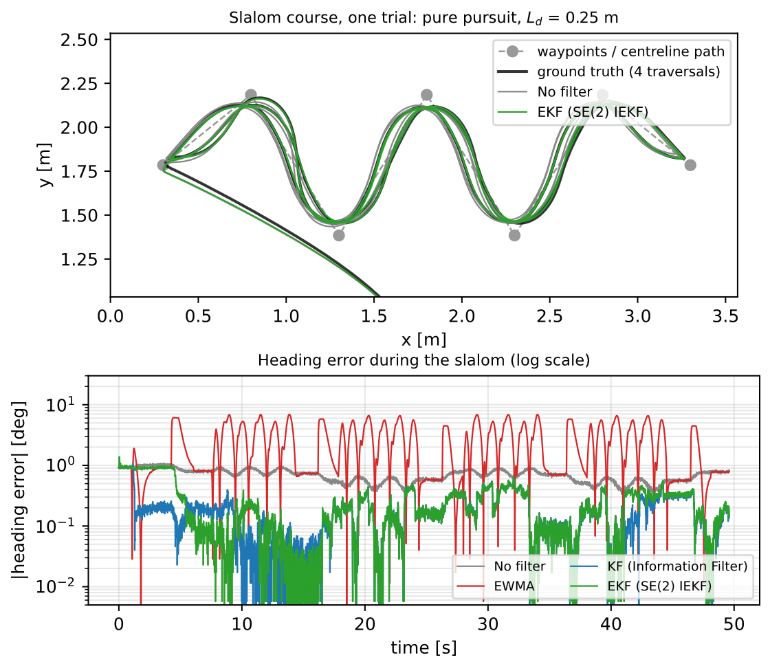
Fig. 1. Slalom course, one trial. Top: pure-pursuit trajectory (look-ahead distance 0.25 m). Bottom: heading error over time, log scale. Opens the full-size image. The IEKF produced a heading RMSE of 0.46 degrees and an ATE of 0.85 cm, against 0.49 degrees and 0.92 cm for the IF; both improved on the unfiltered heading RMSE of 0.60 degrees. EWMA’s heading RMSE of 3.15 degrees was more than five times the unfiltered value, consistent with the smoothing lag of its 40 ms time constant during rapid heading changes.
Outlier and dropout robustness
Robustness was evaluated on the same slalom simulation over a 10 s segment, with 20 seeds per condition. In the outlier condition each GPS update had a 10 percent probability of a 0.5 to 1.0 m position outlier per axis; in the dropout condition each update had a 30 percent probability of being dropped; a third condition combined both. The unfiltered and EWMA configurations receive no GPS corrections and are unaffected.
Table 4. Outlier and dropout robustness, 20 seeds. ATE and heading RMSE are mean ± standard deviation across seeds; peak error is the mean across seeds. Condition Estimator ATE (cm) Peak error (cm) Heading RMSE (°) Baseline IF 0.54 ± 0.13 1.01 0.27 ± 0.10 Baseline IEKF 0.52 ± 0.10 1.01 0.26 ± 0.09 10% outliers IF 7.63 ± 3.13 19.79 0.28 ± 0.08 10% outliers IEKF 7.65 ± 3.14 19.73 1.06 ± 0.43 30% dropout IF 0.66 ± 0.17 1.21 0.31 ± 0.09 30% dropout IEKF 0.62 ± 0.14 1.20 0.29 ± 0.08 Both IF 6.21 ± 3.27 15.28 0.29 ± 0.09 Both IEKF 6.27 ± 3.23 15.38 0.83 ± 0.32 Neither GPS-corrected estimator rejects outlying measurements. Under 10 percent injected outliers, mean ATE rose by more than an order of magnitude for both, and mean peak position error reached approximately 0.20 m. The estimators differed in heading: the IF’s heading RMSE was nearly unchanged (0.27 to 0.28 degrees) while the IEKF’s rose from 0.26 to 1.06 degrees. GPS dropout at 30 percent produced only small increases in ATE for either estimator.
Computational cost
Cost was compared analytically from the update equations, counting persistent scalar values and approximate arithmetic operations per 10 ms update with the 5 Hz GPS update amortized over the 20 prediction steps between readings.
Table 5. Analytical computational cost comparison. Estimator Persistent scalar values Operations per update (approx.) Relative cost (IEKF = 1.0) No filter 3 9 0.06 EWMA 6 22 0.16 IF 12 16 0.11 IEKF 30 140 1.00 By this count the IEKF requires approximately 8.8 times as many operations per update as the IF and 6.4 times as many as EWMA, chiefly from propagating and updating its 3 by 3 covariance. These are relative analytical estimates, not measured execution times on the V5 Brain.
Discussion
Increasing estimator sophistication did not produce uniform improvement. A key distinction is absolute correction: EWMA smooths but cannot control accumulated drift, while the GPS-corrected IF and IEKF reduced it substantially. The IEKF achieved slightly lower errors than the IF, particularly under heading-intensive motion, suggesting a potential benefit from its coupled SE(2) representation, at the price of greater observed heading sensitivity to GPS position outliers and higher analytical computational cost. The heading and robustness evaluations were conducted in simulation, the theoretical properties of invariant filtering were not evaluated directly, and computational cost was estimated rather than measured on the device; physical stress testing, robust measurement updates, on-device timing, and filter-consistency analysis are left to future work.
Author contributions
Moon Liu designed and executed the experiments, including data collection on the VEX V5 system, led preparation of the manuscript, and contributed to the analysis and interpretation of results. Ke Yang, Assistant Professor in the School of Engineering at Texas A&M International University, provided research guidance and supervision throughout.
References
- Hassanzadeh, I., and Abedinpour Fallah, M. (2008). Design of augmented extended and unscented Kalman filters for differential-drive mobile robots. Journal of Applied Sciences, 8(16), 2901–2906. https://doi.org/10.3923/jas.2008.2901.2906
- Kou, E., and Haggenmiller, A. (2023). Extended Kalman filter state estimation for autonomous competition robots. Journal of Student Research, 12(1). https://doi.org/10.47611/jsrhs.v12i1.5578
- Hartley, R., Ghaffari, M., Eustice, R. M., and Grizzle, J. W. (2020). Contact-aided invariant extended Kalman filtering for robot state estimation. The International Journal of Robotics Research, 39(4), 402–430. https://doi.org/10.1177/0278364919894385
- Valade, A., Acco, P., Grabolosa, P., and Fourniols, J.-Y. (2017). A study about Kalman filters applied to embedded sensors. Sensors, 17(12), 2810. https://doi.org/10.3390/s17122810
- Naveen, A., Morris, J., Chan, C., Mhrous, D., Helbling, E. F., Hyun, N.-S. P., Hills, G., and Wood, R. J. (2024). Hardware-in-the-loop for characterization of embedded state estimation for flying microrobots [Preprint]. arXiv:2411.06382
- VEX Robotics. (2026, April 6). Understanding the V5 Robot Brain. VEX Library.
- Purdue University ACM SIGBots. (n.d.). VEX Rotation Sensor C++ API. PROS for V5 Documentation. https://pros.cs.purdue.edu/v5/api/cpp/rotation.html
- VEX Robotics. (n.d.). GPS sensor. VEXcode V5 C++ API.
- Lucas, J. M., and Saccucci, M. S. (1990). Exponentially weighted moving average control schemes: Properties and enhancements. Technometrics, 32(1), 1–12. https://doi.org/10.1080/00401706.1990.10484583
- Pfaff, F., Noack, B., Hanebeck, U. D., Govaers, F., and Koch, W. (2017). Information form distributed Kalman filtering (IDKF) with explicit inputs. In 2017 20th International Conference on Information Fusion (Fusion). IEEE. https://doi.org/10.23919/ICIF.2017.8009724
- Barrau, A., and Bonnabel, S. (2017). The invariant extended Kalman filter as a stable observer. IEEE Transactions on Automatic Control, 62(4), 1797–1812. https://doi.org/10.1109/TAC.2016.2594085
- Arsenault, J. (2019). Practical considerations and extensions of the invariant extended Kalman filtering framework [Master of Engineering thesis, McGill University]. McGill University eScholarship.
- Barfoot, T. D. (2017). State estimation for robotics. Cambridge University Press. https://doi.org/10.1017/9781316671528
Request the manuscript